REVIEW · PORTO
Porto: Tuk tuk vip guided tour – 1.30h
Book on Viator →Operated by Green Tours · Bookable on Viator
Porto is best explored with a plan. This 1.5-hour tuk tuk VIP ride strings together major landmarks with just enough time at each stop to learn what you’re seeing and still keep the day moving. You’ll roll past Romanesque stone, blue-tile station halls, baroque church silhouettes, and viewpoint angles over the riverfront.
Two things I really like about this format are the small size (private for your group, up to 3) and the practical pacing. You get quick guided context at several key points, not just sightseeing snapshots, so places like Sé Cathedral and São Bento Station make more sense fast.
The main drawback to weigh is timing and audio quality. One past booking ran late and shortened the overall experience, and in another case the guide’s English was harder to follow, so if language clarity is crucial for you, keep that in mind.
In This Review
- Key things that make this tuk tuk tour work
- Tuk tuk VIP pacing: why 1.5 hours feels just right
- Where you start (and how to plan around the route)
- Stop-by-stop Porto: what you’ll actually see and why it matters
- Sé Cathedral stop: Romanesque Porto in 10 minutes
- São Bento Railway Station: the story inside the tiles
- Avenida dos Aliados: where the city shows its grand side
- Igreja do Carmo and the Hidden House idea
- Igreja dos Carmelitas: facades you can actually study for 5 minutes
- Hospital de Santo Antonio: why a teaching hospital fits a tourist tour
- Torre dos Clérigos: baroque Porto from the heart of town
- The bookstore pass: a quick taste of Porto’s story-obsessed side
- Porto Judeu: the Jewish quarter, guided context included
- Praca da Batalha: King Pedro V and theater life
- Bridge pass: engineered like the Eiffel Tower
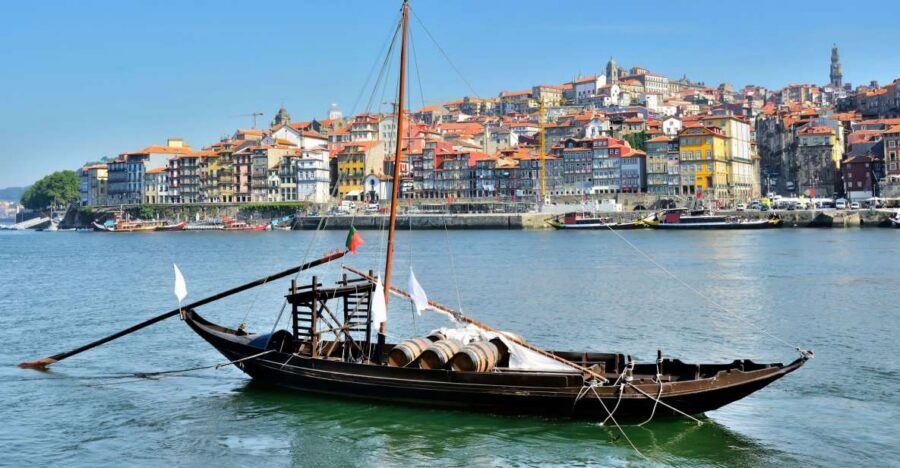
- Miradouro Serra do Pilar: the payoff view over Porto and Gaia
- Timing realities: what can make it feel smooth or frustrating
- Is it good value? A quick way to judge for your trip
- Who should book this Porto tuk tuk VIP tour
- Should you book? My take
- FAQ
- FAQ
- How long is the tuk tuk vip guided tour in Porto?
- How many people is the tour for?
- What is the meeting point for the tour?
- Is the tour offered in English?
- Are tickets or entrance fees included for the stops?
- Is the tour good for people who want to see viewpoints?
- What happens if weather is bad?
Key things that make this tuk tuk tour work

- Private for up to 3 people, which usually means less waiting and more focused explanations
- Early highlights packed in: Sé Cathedral, São Bento, Aliados Avenue, Carmo/Carmelitas area, Clérigos Tower
- Real Porto neighborhoods, including a guided pass/stop with historical notes in Porto Judeu
- Gaia viewpoint time at Miradouro Serra do Pilar, with big-panorama payoff
- Pass-by moments like the Porto bridge and a highly famous ornate bookstore frontage (no long ticket lines built in)
Tuk tuk VIP pacing: why 1.5 hours feels just right
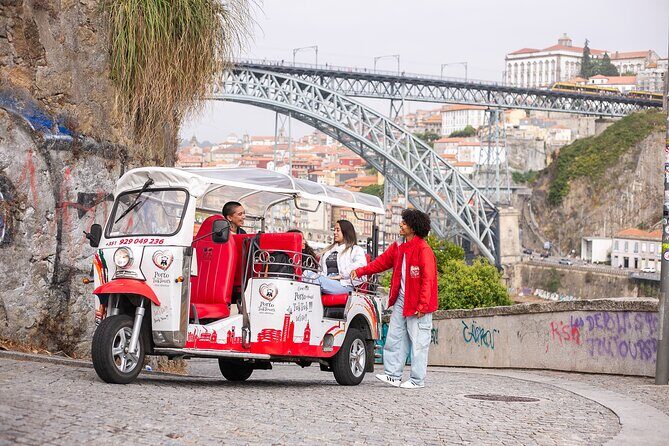
This tour is built for people who want the “greatest hits” of central Porto without committing to a full day. At about 1 hour 30 minutes, it’s long enough to get story and context at several stops, but short enough to fit around lunch, a Douro cruise, or a second evening plan.
The price is $132.17 per group (up to 3), not per person. That matters. If you’re traveling with 2 people, the cost per head becomes a lot more reasonable than most city tours. Even with one traveler, the private setup can still be a good deal if you value comfort and a guide who can answer questions on the fly.
Also, it’s a mobile-ticket tour offered in English. That’s handy if you like a low-stress arrival. And since it’s a tuk tuk, you move efficiently through areas where walking can feel slow when you’re trying to cover many stops.
You can also read our reviews of more guided tours in Porto


Where you start (and how to plan around the route)
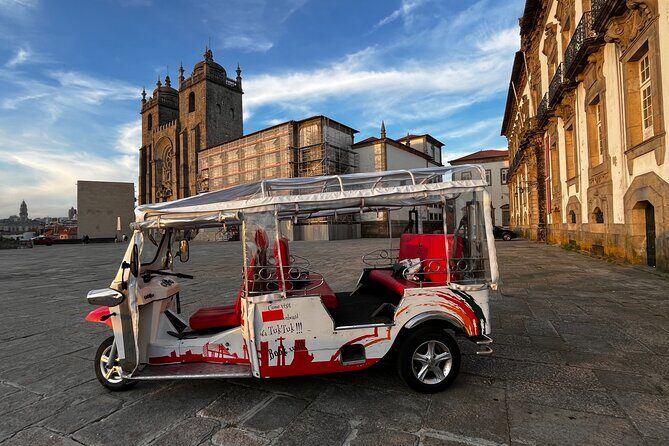
You meet at the statue of Vímara Peres on Calçada de Vandoma, Porto. The tour ends back at the same meeting point, so you’re not left stranded across town. That simple loop matters in a city where getting from one neighborhood to another can turn into a time sink.
Weather can also affect your experience. The tour requires good weather, and if it’s canceled due to poor conditions, you’ll be offered a different date or a full refund. Porto can switch moods quickly, so it’s smart to pair this with a flexible day if your schedule allows.
One more practical note: this tour is listed as near public transportation and most travelers can participate. Still, the stops are short and you’ll be moving in and out of the tuk tuk repeatedly. If you prefer long sits, choose a different style of tour. If you like quick hits and getting your bearings fast, you’ll do well here.
Stop-by-stop Porto: what you’ll actually see and why it matters
Sé Cathedral stop: Romanesque Porto in 10 minutes
Your first stop is Catedral do Porto (Sé Catedral). Construction began in the 12th century, and it’s often described as the oldest monument in Porto. You’ll learn details that give the stonework a backstory, including the idea that the first stone was laid by Queen D. Teresa.
Why it’s worth a quick stop: Sé Cathedral is one of those places where, without context, it can look like just more old stone. With a guide, you notice the age and the role the building played in the city’s identity.
Consideration: admission is not included here, so if you want inside time, you may need tickets on site. Also, the stop is short (about 10 minutes), so think of it as an orientation moment, not a full cathedral visit.
São Bento Railway Station: the story inside the tiles
Next up is Estação São Bento. This is where Porto’s visuals do the talking: the station is famous for its artwork and for the way the space feels like a grand hall instead of a simple transit stop.
Your guide covers the timeline: built in the early 1900s under Carlos D. and Amelia, inaugurated in 1896, with the official line opening on November 7, 1916. In a short stop, that quick history helps you understand why this station became such a cultural reference point.
Good news: admission is free. Even if you don’t go far into the station areas, you still get the big impression. This is also a great stop for photos because the building reads well from different angles.
You can also read our reviews of more tours and experiences in Porto





Avenida dos Aliados: where the city shows its grand side
Then you roll to Avenida dos Aliados, a major boulevard originally named Allied Nations Avenue. It opened in 1916 as part of a renovation plan connecting the city center between Trinity and Liberty squares.
Why this is more than a street stop: it gives you a sense of Porto’s layout and civic pride. After the older stone of Sé, Aliados feels like the “modern” city talking—wide, formal, and built for movement.
Admission is free. The stop is brief (about 10 minutes), so use it to orient yourself and spot the buildings the guide points out.
Igreja do Carmo and the Hidden House idea
You then visit the Igreja do Carmo area. There’s a neat story here: the land next to the Carmelite Church on the west side was given to the Order in 1752. Because they couldn’t build two churches together at the time, something unusual happened: the so-called Hidden House was built between them, and your guide explains the setup.
This is one of the stops that turns quick sightseeing into real understanding. It’s not just church facades. It’s the logic of how the space was allowed to exist.
Admission is listed as not included for this stop. Also, the time is short (about 5 minutes), so come ready to look closely and listen.
Igreja dos Carmelitas: facades you can actually study for 5 minutes
Right after, you stop at Igreja dos Carmelitas. It’s tied to Porto’s construction story starting in the 17th century. You’ll have time to observe the facades while the guide walks you through what you’re seeing.
Admission is not included here either. But even without tickets, the exterior can be very readable when someone tells you what lines, proportions, and details to pay attention to.
Hospital de Santo Antonio: why a teaching hospital fits a tourist tour
This is the unexpected one: Hospital de Santo Antonio. It’s described as a central general and university hospital tied to teaching at ICBAS, the Abel Salazar Institute of Biomedical Sciences, at the University of Porto.
Why it shows up: this tour isn’t only about monuments. Porto is a working city, and this hospital stop gives you a glimpse of modern institutions shaping the center. You won’t get a deep medical tour in 5 minutes, but you get the idea that Porto’s identity isn’t frozen in time.
Admission is free.
Torre dos Clérigos: baroque Porto from the heart of town
Finally in this first run of central stops, you reach Torre dos Clérigos, with the church and tower often cited for baroque style. It’s placed in the city core, which is perfect for quick-impact viewing.
Admission is not included for this stop. If you want the tower itself, plan for tickets not being included. The stop duration is around 5 minutes, so this is best thought of as a highlight moment—get your bearings, take photos, and let the guide’s explanation frame the architecture.
The bookstore pass: a quick taste of Porto’s story-obsessed side
Between major religious and civic sights, the route includes a pass by what’s presented as the most beautiful bookstore in the world. The tour doesn’t advertise long time inside, so treat it as a look-and-remember photo moment and a reminder that Porto’s culture runs on books and stories.
No admissions are mentioned here, so it’s likely just a pass-by.
Porto Judeu: the Jewish quarter, guided context included
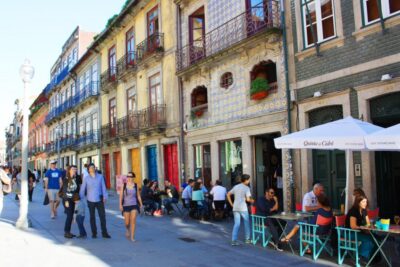
Next you stop for Porto Judeu, with guided historical information about the Jewish quarter. This is one of the reasons I like short tours that actually include neighborhood interpretation. You’re not only seeing buildings—you’re learning what lived there and what historical forces shaped the streets.
Admission is free, and the stop is about 10 minutes.
Praca da Batalha: King Pedro V and theater life
Then comes Praca da Batalha. Since 1866, the square has been dominated by the monument to King Pedro V, designed by Teixeira Lopes. The square is also home to São João National Theatre and Cine-Teatro Batalha.
Why this stop is useful: it links architecture to civic culture. A square like this is where Porto’s public life spills out, and the monument gives you an easy visual anchor.
Admission is free, with about 10 minutes at the stop.
Bridge pass: engineered like the Eiffel Tower
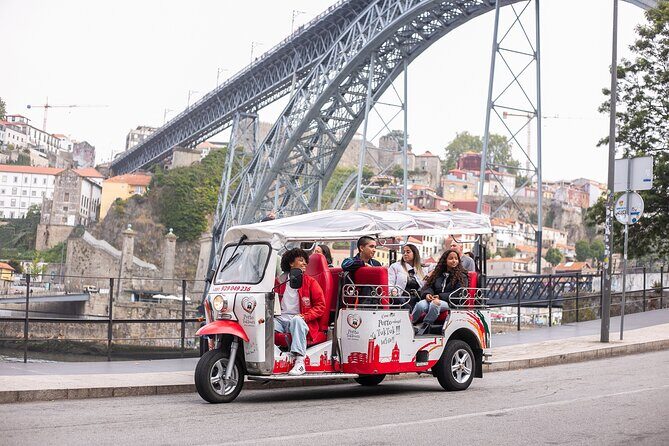
On the way to the viewpoint, you pass by a well-known Porto bridge designed by the same engineer as the Eiffel Tower: Gustave Eiffel. Even if you’re not stopping for a long crossing, the pass keeps the skyline storytelling going.
This is one of those “move and look” moments. If your phone camera can handle motion, this is a good time to try for a clean skyline shot.
Miradouro Serra do Pilar: the payoff view over Porto and Gaia
The tour ends with Miradouro Serra do Pilar, a viewpoint with panoramic views over Porto and Gaia. It’s marked as free, and the stop is about 10 minutes.
This is the reason the whole route feels satisfying: after churches, squares, and station tiles, you finally get the big picture. If you’re there at sunset, you’ll feel the emotional hit that makes Porto memorable.
Timing realities: what can make it feel smooth or frustrating
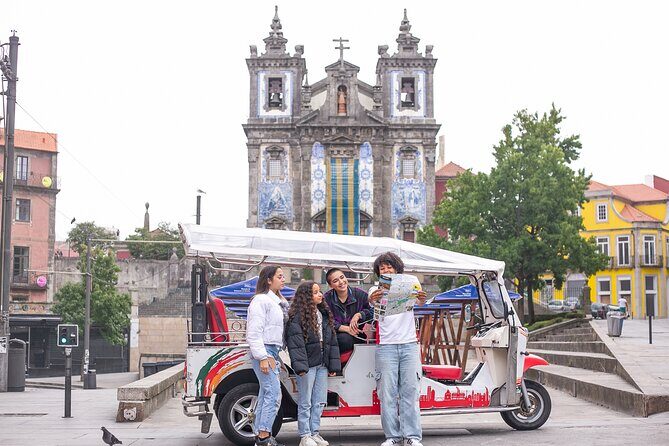
The ideal experience is 1 hour 30 minutes with multiple short, purposeful stops. The tour is generally praised for guides who know Porto deeply and share it with energy. In at least one case, the guide named Julianna was described as fun and knowledgeable, with extra local life details that made the city feel close (including restaurant recommendations like Lucky Duck, noted for cod fritters and coffee).
The most important caution is that short tours don’t forgive delays. If your guide starts late, those stop windows shrink quickly. One account described a 25-minute late start that led to at least one stop being closed for the evening and reduced the experience length (from a booked 90 minutes down to around 75 minutes). Another account mentioned difficulty hearing the driver and a heavily accented English, which can matter if you want every explanation to land.
Also, tuk tuks are vehicles, so mechanical issues can happen. One booking described a tuk tuk breakdown at the start, then a replacement vehicle sent out so the tour could continue.
My practical advice: if you care about hearing every detail, pick a quieter time of day and keep your expectations realistic. Bring water. Have your phone ready for quick photo moments. And if you’re sensitive to language, consider confirming the English experience and asking a question early in the ride.
Is it good value? A quick way to judge for your trip
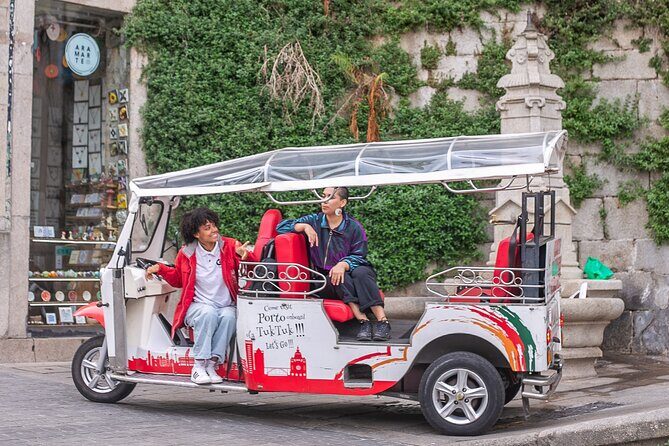
This tour’s value depends on how you travel.
Best value for:
- 2–3 people in a group who want private transportation and minimal walking
- First-timers who want the central storyline of Porto in a tight loop
- Travelers who like photo-rich stops and don’t need long museum-style visits
Not the best fit for:
- People who want deep interior visits at churches and towers (multiple stops list admission as not included and time is short)
- Anyone who struggles with short explanations and prefers long, slow wandering
Because some stops have admission not included (like Sé and several church/tower locations), your total day budget might rise a bit if you choose to go inside. That’s normal, just plan for it.
Who should book this Porto tuk tuk VIP tour
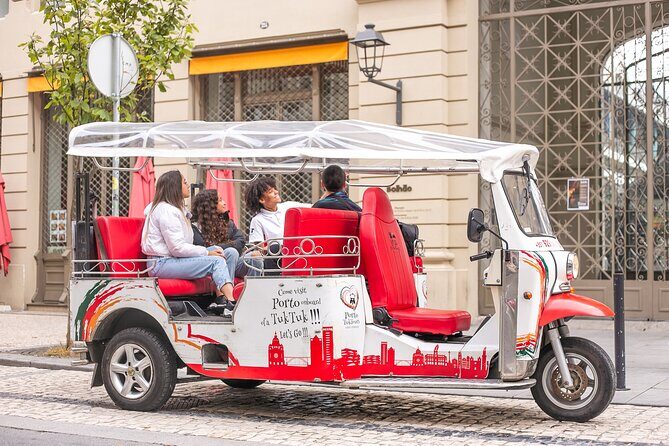
Book it if you want a guided shortcut through central Porto: you’ll get the big sights, the street-level context, and a viewpoint finale without draining your energy.
It’s also a smart option if you’re on a tight schedule and want sunset potential. One booking described booking a 7 pm tour and catching sunset over the city. If you can, aim for a late afternoon or early evening slot.
If you’re a “tell me the story” kind of traveler, this setup helps. Even the station and square stops come with specific historical notes, from the timeline behind São Bento to the monument designer at Praca da Batalha.
Should you book? My take
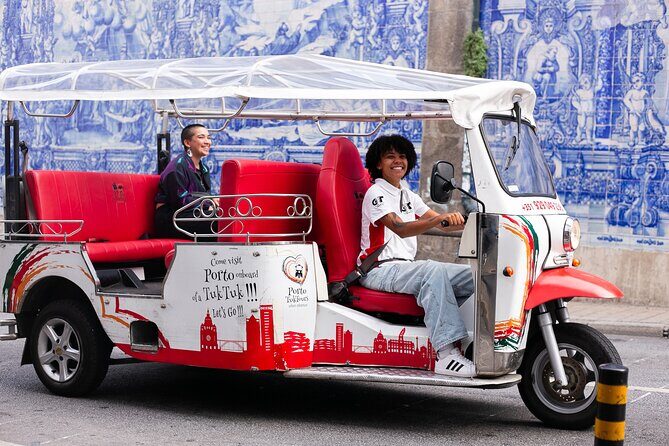
I’d book this tour if you want structure. Porto can be twisty and hilly, and a tuk tuk route with a guide gives you a clean way to see a lot without guessing.
I would hesitate only if you’re extremely time-sensitive or if you know you need very clear English narration to enjoy city history. The stop list is strong, but the whole experience depends on timing and communication.
If you do book, go in with the right mindset: think short stops, photo moments, and guided context. Not a slow deep visit.
FAQ
FAQ
How long is the tuk tuk vip guided tour in Porto?
It runs about 1 hour 30 minutes.
How many people is the tour for?
It’s private for your group and listed as up to 3 people.
What is the meeting point for the tour?
The tour starts at the statue of Vímara Peres on Calçada de Vandoma, 4000-013 Porto, Portugal, and ends back at the same meeting point.
Is the tour offered in English?
Yes, it’s offered in English.
Are tickets or entrance fees included for the stops?
Not all of them. Sé Cathedral and several churches/tower entries are marked as admission not included, while other stops like São Bento Station and most squares/viewpoints are listed as free.
Is the tour good for people who want to see viewpoints?
Yes. The route includes Miradouro Serra do Pilar with panoramic views over Porto and Gaia.
What happens if weather is bad?
The tour requires good weather. If it’s canceled due to poor weather, you’ll be offered a different date or a full refund.