REVIEW · PORTO
Cruise Shore Excursion – Private Tuk Tuk Tour to the Historic Center
Book on Viator →Operated by Portuk · Bookable on Viator
A tuk tuk is a way to start Porto.
This private cruise shore excursion mixes big-name sights with smaller, quieter stops—plus nonstop guide talk about how Porto’s trade, sea life, and architecture shaped what you see today.
I especially love the way the tuk tuk keeps you moving on narrow, hilly streets without turning the day into an endurance test. I also like the pacing: you get enough time at key viewpoints like Passeio das Virtudes and Serra do Pilar, then you’re back to rolling through the center with practical tips for what to eat and where to wander next.
One drawback to weigh: the day is built around sightseeing, not shopping, and paid entries for some major interiors are not included—so plan for a little extra cost if you want to go inside places like Torre dos Clérigos or Livraria Lello.
In This Review
- Key things to know before you go
- How the tuk tuk timing works with a cruise day
- Pickup, route style, and why the small vehicle matters
- First river views and seafaring Porto energy
- Passeio das Virtudes: a viewpoint that explains the river
- A photo museum in a former prison building
- Cordoaria Garden and the calm side of the center
- Torre dos Clérigos and how to plan your climb
- Livraria Lello: the Art Nouveau façade and the red staircase
- Churches with tile work, not just pretty façades
- From the Stock Exchange area to iron architecture and gold interiors
- Dom Luís I and the metro deck you can’t miss
- Praça da Ribeira: oldest streets, wine-funded redesign, and fountain details
- Serra do Pilar monastery: the circular cloister view
- Ponte do Infante and the modern bridge record
- Ending in Batalha square and the tile-covered details
- Bolhão Market stop: a fun plan B if it’s closed
- Price and what you actually get for $106.93
- Should you book this Porto historic center tuk tuk tour?
- FAQ
- How long is the private tuk tuk tour in Porto?
- Does the tour include pickup from the cruise ports?
- Is the tour really private?
- What’s included in the price?
- Are monument entrances included?
- What happens if the weather is bad?
- Can I cancel for free?
Key things to know before you go
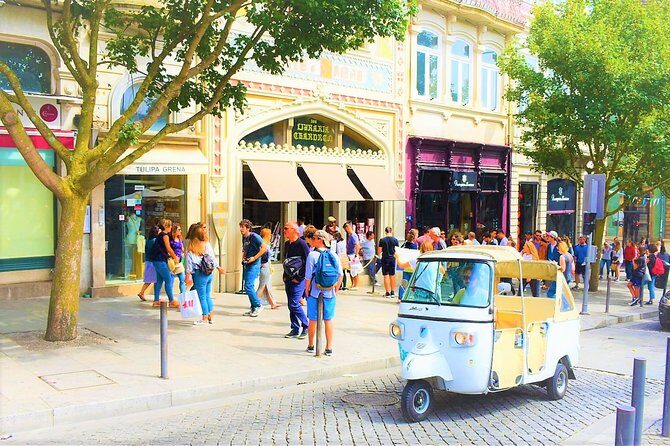
- Tuk tuk access for tight lanes and steep areas where cars and buses struggle
- River panorama stops with big viewpoint payoff from Passeio das Virtudes and Mosteiro da Serra do Pilar
- Major Porto icons on a cruise-friendly timeline like Torre dos Clérigos and Livraria Lello (paid entry)
- Art and design variety across gardens, churches, and photography and tile details
- A Port wine glass included during the tour, often at a scenic stop
- Cobblestones and fit matter: some tuk tuks work best for two, and rough road sections can feel bumpy
How the tuk tuk timing works with a cruise day
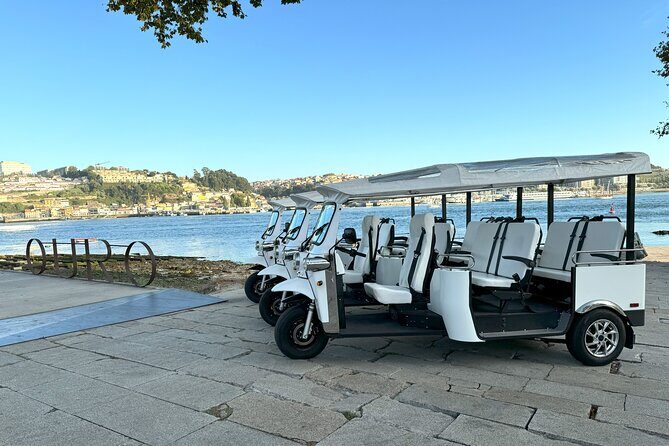
This tour is designed for a tight cruise schedule. Pickup is offered from the main gate at Leixões Port, Matosinhos Port, and Doca Norte, and the tour starts no later than 1 hour after your ship arrives.
The big practical win is that you’re not trying to get across town by yourself first. You also get a mobile ticket and onboard live commentary, so you can focus on the views instead of figuring out routes and stops.
The day runs about 3 hours 30 minutes. That’s long enough to get oriented across the historic center and viewpoints, but short enough that you still feel fresh for dinner back in Porto or across the river in Gaia.
You can also read our reviews of more boat tours in Porto


Pickup, route style, and why the small vehicle matters
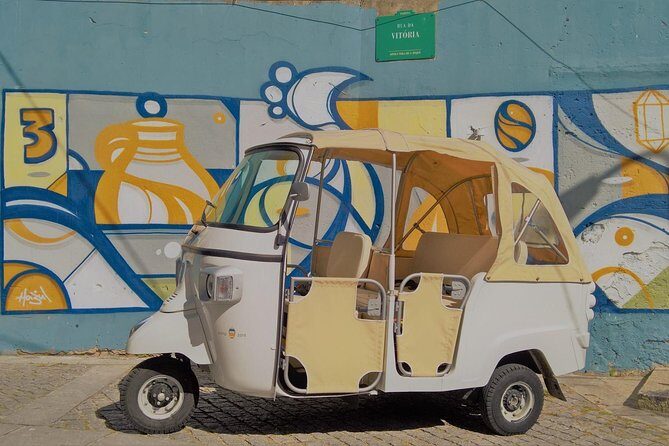
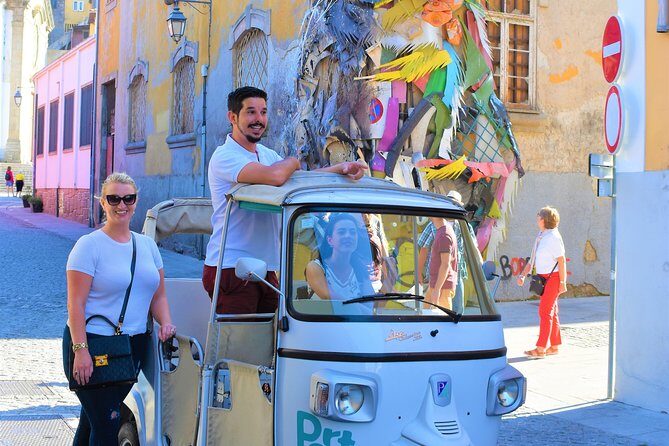
A tuk tuk changes the feel of the day. It’s small enough to slide into lanes bigger vehicles avoid, and it helps you dodge a lot of the stress that comes with Porto’s hills.
In real life, this means you’ll spend more time looking around than walking between highlights. It also explains why the tour can hit places like church squares and garden areas with less backtracking.
One thing to keep in mind: cobblestones can be rough. If you have back issues, or you hate rattle-and-bounce transport, you’ll want to mentally prepare for that part of Porto.
First river views and seafaring Porto energy
You start with a set of sights that quickly frames Porto’s identity as a sea-and-industry city. There’s a sculpture concept that points to Porto and nearby Matosinhos’s seafaring and industrial heritage, including network details tied to the fishing industry.
Next you’ll see a hexagonal granite tower detail—painted support elements, a red balcony and lantern, and a small annex with white plaster walls. These stops are short, but they do a useful job: they teach your eye what to notice later when you’re walking on your own.
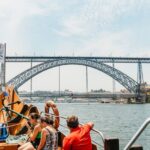
Then the route gives you a major engineering stop: the Arrábida Bridge. It carries six lanes over the Douro River between Porto and Vila Nova de Gaia, and it was finished and inaugurated in 1963. At opening time, its main span of 270 meters was the largest of any concrete-arch bridge in the world. You get the scale, plus the why behind it.
After that, you’ll head to one of the classic scenic terraces.
Passeio das Virtudes: a viewpoint that explains the river
Passeio das Virtudes is the kind of stop that makes Porto click. From the lane, you look down toward the Douro mouth bar, with terraces stretching toward São Pedro de Miragaia.
In front you’ll spot the Fountain of Virtudes, and along the river you can see the former Customs House building. Even if you don’t go inside anything, the view helps you understand why ships mattered here.
This stop is also a good breathing point: about 10 minutes, admission-free, and the timing is short enough that you won’t lose the rest of your day.
A photo museum in a former prison building
One of the smartest mid-tour stops is the polygonal granite building dating from 1582, rebuilt in 1767 in a neo-classical style. It has 103 windows arranged in a geometric pattern, and it historically served as a prison.
This matters because it turns a “random big stone building” into a story. Names like Camilo Castelo Branco and Zé do Telhado are tied to incarceration there, and learning that context makes the architecture feel less like décor and more like evidence of real lives.
Between 1999 and 2002, it was restored under Eduardo Souto de Moura and Humberto Vieira and became the Portuguese Centre for Photography. Even if you’re not planning to spend long indoors, this stop gives you a strong theme for the day: Porto turns industry and hardship into culture.
You can also read our reviews of more private tours in Porto


Cordoaria Garden and the calm side of the center
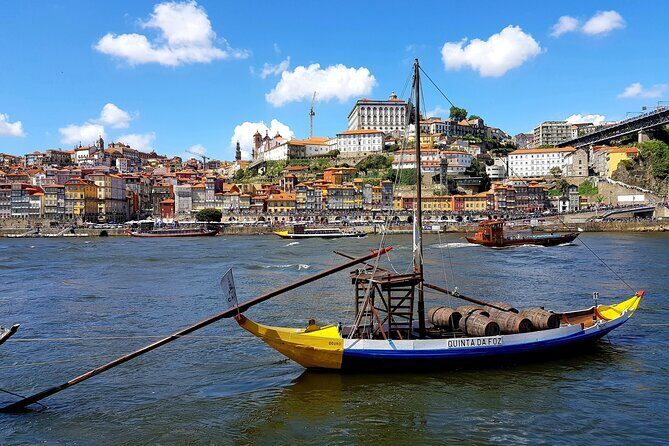
Cordoaria Garden—also called Jardim de João Chagas—adds a softer pace after the bridges and stone. The story is tied to rope makers who stayed in the area for about 200 years.
You’ll learn about the garden’s transformation into a public space around 1865/1866 under German landscaper Emile David. Statues of Ramalho Ortigão and António Nobre sit in the garden, and there are also later sculptures by Juan Muñoz from 2001.
One charming detail is how the garden functions as a real community space, not just a postcard. There’s a miniature golf course, and bandstand concerts happen occasionally. Admission is free, and the stop time is short enough to keep your day moving.
Torre dos Clérigos and how to plan your climb
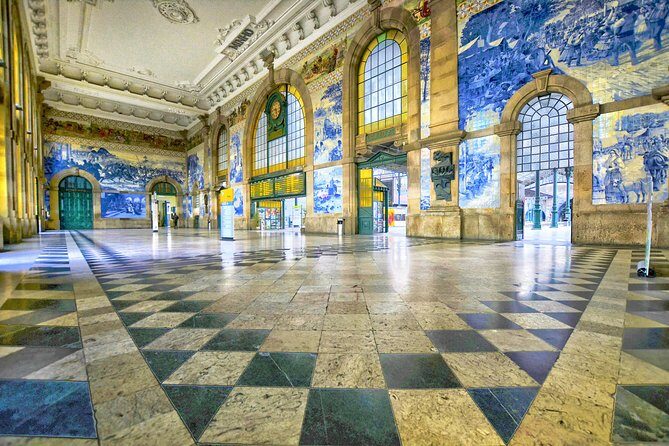
The Clérigos Tower is one of Porto’s most emblematic monuments. It’s a baroque work by Nicolau Nasoni from the first half of the 18th century.
The climb is famous: about 240 steps. The tour includes time at the area, but entry to the tower is not included, so you’ll need to decide on the spot if you want to add that ticket.
What you’re really buying with that decision is the panoramic reward. From the top, you look over the city and the Douro River. If your legs are fine, it’s worth it. If you’d rather save energy, you can still appreciate the exterior and then spend more time elsewhere.
Livraria Lello: the Art Nouveau façade and the red staircase
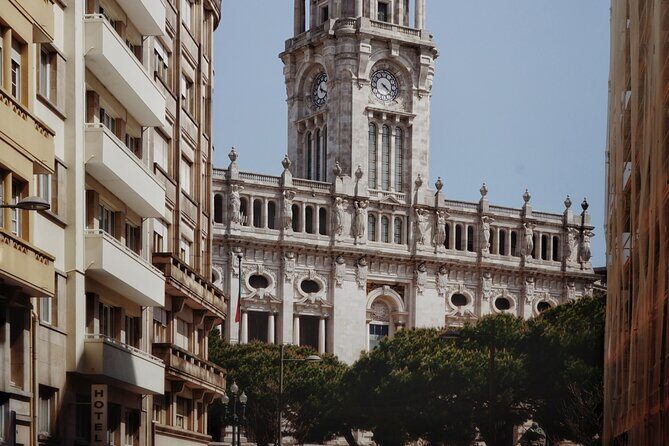
Next comes Livraria Lello, housed in a building inaugurated in 1906. The façade is Art Nouveau with neo-Gothic details, and inside you’ll find painted plaster that imitates wood.
You’ll also see a large stained-glass skylight bearing the library monogram and motto: Decus in Labore. Another highlight is the staircase linking floors, noted as one of Porto’s first reinforced concrete works.
Like the tower, admission isn’t included. That’s why this stop works best if you’re ready for an extra ticket purchase if you care about interiors. If you’re mainly interested in the exterior and the architecture from outside, you’ll still enjoy the stop.
Churches with tile work, not just pretty façades
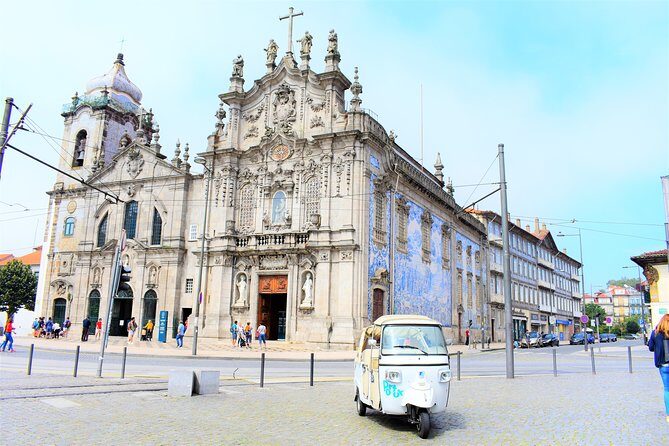
Porto’s church stops are brief here, but they’re chosen for detail.
At Igreja do Carmo, focus on the rococo architecture and the carved interior. In 1912, its lateral façade was covered with tiles, designed by Silvestre Silvestri, with figurative scenes tied to the cult of Nossa Senhora.
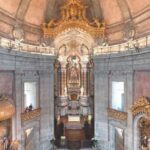
At Igreja dos Carmelitas, you’ll see a 17th-century church with a classical façade dating from the 1850s, with the project attributed to Nicolau Nasoni. The altarpiece is described as Porto rococo style, and the building is a national monument.
These are not “long worship experience” stops. They’re architectural reading sessions. If you like noticing craftsmanship—especially tile, wood carving, and façade proportions—this part of the tour gives you a lot fast.
From the Stock Exchange area to iron architecture and gold interiors
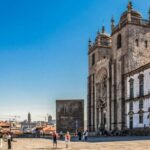
One of the most historically packed stretches comes around the riverfront monuments: Mercado Ferreira Borges and Palácio da Bolsa sit in the historic center area.
Palácio da Bolsa (Stock Exchange Palace) is a national monument. It was designed in a neo-classical style in 1842 and is tied to the Commercial Association of Porto. Its major highlight is the Arabian Room, though entry is not included.
Mercado Ferreira Borges is a big contrast in materials. Built in 1885 with iron architecture, it later shifted to entertainment use, including becoming the home of Hard Club. It’s a short stop time here, but it adds variety beyond stone churches and baroque towers.
Then you’ll reach Igreja de São Francisco. This is Porto’s most important Gothic temple, started in the 14th century, with a gilded interior from the 17th and 18th centuries. People describe the woodwork as so rich it’s hard to compare to anything else.
There’s also the Tree of Jesse and catacombs. Admission isn’t included, so you’ll have to decide whether you want to pay to go inside. If you don’t, you can still get the “what kind of church is this” feeling from the overall exterior presence.
Dom Luís I and the metro deck you can’t miss
From the church zone, the tour shifts to one of Porto’s most iconic engineering photos: the Ponte Dom Luís I.
This iron bridge was planned by Teófilo Seyrig, a disciple of Eiffel, and inaugurated in 1886. It has two overlapping iron decks, and it’s still known for having one of the world’s biggest forged-iron arches.
Today, the upper deck is used by Porto’s metro line, connecting the Cathedral area to the Jardim do Morro and onward toward Avenida da República in Vila Nova de Gaia. That detail matters because it shows Porto’s old infrastructure keeps living in modern daily life.
Praça da Ribeira: oldest streets, wine-funded redesign, and fountain details
Praça da Ribeira is one of the oldest squares in the city. It developed as a commercial center with fish market energy and shop tents, and later João de Almada e Melo pushed a major 18th-century remodeling.
What makes the story fun is that wine revenue financed parts of the project. Archaeological work in the 1980s led to a discovered fountain from the 17th century, reconstructed in its original location, then crowned with a sculpture known popularly as the Cube of the Ribeira.
You’ll also hear about the unveiling of a St. John the Baptist statue in 2000. This square is also closed to vehicles in the area you’ll be moving through, so it feels safer to linger and look around.
And yes, this is also a strong place to plan dinner after you finish the tour, since nightlife happens nearby.
Serra do Pilar monastery: the circular cloister view
Mosteiro da Serra do Pilar is UNESCO-listed and dates to construction beginning in 1538, with completion around 1670. It started with Augustinian friars and later went through turmoil during the Civil War period in the 1830s.
The restoration effort later took shape through a brotherhood connected to Lady of the Pilar and recovery work that brought the monastery back to life.
The church is circular with a dome and surrounding balcony. The cloister is also circular with 36 Ionic columns, the only example of its type in Portugal. This is one of those stops where the details are the point, not just the photo.
Then comes the terrace. From up here, you get a sweeping view across the entire riverside toward Porto and Gaia. You can see the historic center, with the Cathedral and D. Luís I bridge, plus the Arrábida Bridge. In the other direction you’ll see Fontainhas and the São João bridge.
Admission is free, and the stop time is short enough that you get the view without losing your day.
Ponte do Infante and the modern bridge record
After Serra do Pilar, the tour includes another major bridge story: the Ponte do Infante, inaugurated in 30 March 2003.
It replaced the upper deck lane of D. Luís I bridge, with that old lane now used by the metro line D. The bridge’s deck is 371 meters long and 20 meters wide, and it follows a Maillart-type arch design with a 280 m arch span—described as a world record by experts.
You’ll see how the river is still the main stage, but the technology has changed. This stop is a nice reminder that Porto is not only old stone; it’s engineering and living systems.
Ending in Batalha square and the tile-covered details
Praca da Batalha dominates with a monument to D. Pedro V and sits near major theater landmarks like São João National Theatre and Cine-Teatro Batalha.
The National Theatre São João building was constructed in 1910 on ruins of a real theatre that burned down in 1908. It has stylistic emblems connected to pain, quality, hate, and love, and the façade design is inspired by renovation in the Luís XVI style.
Near the theater area, there’s a chapel built at the beginning of the 18th century. The interior includes the image of Nossa Senhora das Almas, and the exterior was tiled in 1929 with panels showing scenes from the life of St. Francis of Assisi and St. Catherine. Those tile panels were recovered in 1982.
These are small stops, but they’re high reward for anyone who loves religious art details and tilework.
Bolhão Market stop: a fun plan B if it’s closed
Bolhão Market is the city’s most famous market and dates back to 1850. It has neoclassical architecture and two floors, with sellers organized by specialty—fishmongers, butchers, green grocers, and florists.
One practical catch: the market is currently closed for refurbishment works. That means you can still see the surrounding area and understand why it’s famous, but you won’t get the full “shop inside” experience from this stop.
If you plan to shop for food items, you may want to do that on your own after the tour.
Price and what you actually get for $106.93
At $106.93 per person for about 3 hours 30 minutes, this isn’t a bargain tour. It is, however, priced like a real guided experience with a small vehicle and time pressure handled for you.
The tour includes a driver/guide, live commentary on board, a local guide, and an alcoholic Port wine glass. What’s not included is monuments entrance, which matters because two of the big names—Torre dos Clérigos and Livraria Lello—are specifically listed as not included.
So the value comes down to your priorities:
- If you want a guided “see Porto fast” orientation and you’re okay paying for select interiors, you’ll likely feel it’s worth it.
- If you only want outside views and you dislike extra ticket add-ons, you may feel like the price is higher than you needed.
Also, the tour requires good weather. If conditions are poor, you’ll be offered a different date or a full refund.
Should you book this Porto historic center tuk tuk tour?
Book it if you want an efficient Porto orientation with real guide context, and you like your sightseeing paired with viewpoints. The tuk tuk format is especially helpful if you don’t want to slog through Porto’s hills on foot.
Skip it or rethink if your day is built around long interior visits and lots of shopping time. Also consider that tuk tuks may feel tight if you’re more than two people, and cobblestones can get bumpy.
If you’re the type who wants to see famous landmarks quickly, then use the tour to choose where to return on your own, this is a strong fit.
FAQ
How long is the private tuk tuk tour in Porto?
It runs for about 3 hours 30 minutes.
Does the tour include pickup from the cruise ports?
Yes. Pickup is offered from the main gate at Leixões Port, Matosinhos Port, and Doca Norte.
Is the tour really private?
It’s listed as a private tour/activity, with only your group/family participating. A minimum of 2 people per booking is required.
What’s included in the price?
The price includes the driver/guide, live commentary on board, a local guide, and an alcoholic Port wine glass.
Are monument entrances included?
No. Monuments entrance is not included, and some key stops list admission as not included.
What happens if the weather is bad?
The experience requires good weather. If it’s canceled due to poor weather, you’ll be offered a different date or a full refund.
Can I cancel for free?
Yes. You can cancel up to 24 hours in advance for a full refund. If you cancel less than 24 hours before the start time, the amount paid won’t be refunded.