REVIEW · PORTO
Private Tour to Guimarães and Braga, two incredible cities
Book on Viator →Operated by Endless Weekend Tours · Bookable on Viator
Two medieval cities. One smooth day.
This private outing from Porto strings together Guimarães and Braga with a licensed guide/driver, so you can focus on the monuments instead of negotiating trains or parking. The plan is built around major sights plus viewpoints—exactly the kind of day that feels efficient, but not rushed.
I especially love the comfort and pacing. The luxury vehicle comes with Wi‑Fi, bottled water, and refreshments, and the guide (often Carlos) adjusts the stops to match what you care about—whether that means lingering longer or shifting order. I also like that you get a true walking tour feel in the old quarters, with lots of short stops where the guide points out details you’d miss alone.
One consideration: ticket costs add up. Some of the most famous places here are optional or paid, like the Dukes of Braganza palace museum, Guimarães Castle, the Braga Cathedral area, and the funicular, and lunch isn’t included.
In This Review
- Key points worth knowing
- How a private Guimarães and Braga day works from Porto
- Entering Guimarães: Igreja de Nossa Senhora da Oliveira
- Oliveira square, civic power, and the story behind the town hall
- Padrao do Salado and the medieval town’s memory
- Medieval squares and the most medieval street in Guimarães
- Museum and palace choice: Paco dos Duques de Bragança
- Igreja de São Miguel do Castelo: Romanesque with national importance
- Guimarães Castle: the views and the origin story
- Toural Square and Arco da Porta Nova for quick city rhythm
- Braga’s quieter elegance: Largo do Paço and Santa Barbara Garden
- Torre de Menagem and the remains of medieval defense
- Braga Cathedral area: where Romanesque, Gothic, and Baroque meet
- Bom Jesus funicular and the UNESCO sanctuary above Braga
- Price and what you should budget for real value
- Who this Guimarães and Braga private tour suits best
- Should you book this Guimarães and Braga private day?
- FAQ
- What is the duration of the private tour?
- What time does the tour start, and where does it begin?
- Is pickup available from hotels in Porto and Gaia?
- Is this tour private?
- What language is the tour offered in?
- What’s included in the tour price?
- Is lunch included?
- Which major stops require optional tickets?
- Are there any free admissions on the itinerary?
- What happens if weather is poor?
- Are service animals allowed?
Key points worth knowing
- Licensed guide/driver who can tailor the route to your interests
- Wi‑Fi and refreshments in the vehicle keep the day comfortable
- Guimarães medieval core built around monasteries, squares, and castles
- Braga hilltop experience with the Bom Jesus funicular and UNESCO sanctuary
- Several optional paid entries (plan your budget before you go)
- English tour and a private format with only your group
How a private Guimarães and Braga day works from Porto
This is the kind of tour that feels made for a full, high-impact day. You meet at Praça da Liberdade 19 in Porto at 8:00am, and the activity returns to the same meeting point. Pickup is offered from hotels and B&Bs in Porto and Gaia downtown, which matters because it removes the awkward part of day trips: figuring out logistics before you even start seeing things.
The duration is listed as about 8 to 10 hours. That’s long enough to cover two cities properly, but not so long that you’re stuck in the car the whole time. The vehicle setup is also practical—Wi‑Fi, bottled water, refreshments, and a comfortable ride—so you can treat the day like a walking-and-sightseeing marathon rather than a travel chore.
Because it’s private, you’re not stuck with the slowest pace or forced to keep up with a crowd. The guide can also shift priorities. In real life, that means if you want more time at a certain church doorway detail or prefer coffee breaks, the route can flex without turning the day into chaos.
You can also read our reviews of more tours and experiences in Porto.



Entering Guimarães: Igreja de Nossa Senhora da Oliveira
Guimarães kicks off with Igreja de Nossa Senhora da Oliveira, and it’s a strong opener. The site’s occupation traces back to a pre-Romanesque monastery, founded by Mumadona Dias in 949. It’s not just an attractive church—this is a place tied to the deep roots of Portuguese identity.
You can also benefit from the guide’s explanation because the architecture and setting make more sense when you know what came first: monastery foundation (949), then the later church complex, then centuries of evolving design. The stop is short on the schedule (around 10 minutes), but it’s the kind of stop where 10 minutes can still give you a lot if you’re paying attention.
The practical upside: admission is free here. The slight drawback: if you love museums and interior viewing, this first stop may feel more like orientation than a full deep-dive. Still, it’s a smart way to get your bearings fast.
Oliveira square, civic power, and the story behind the town hall
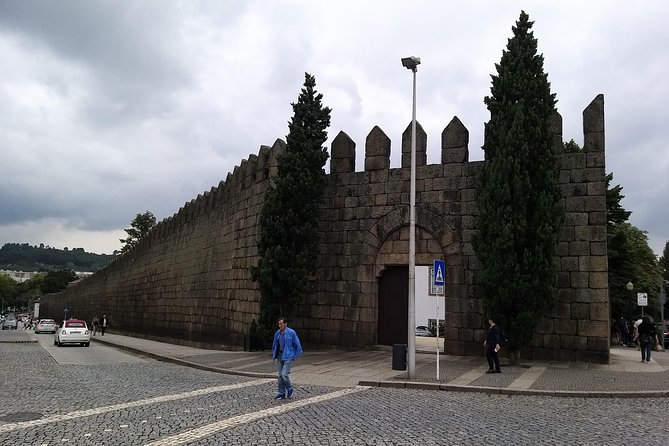
Next is Largo da Oliveira, with Antigos Paços do Concelho, the Old Town Hall. Construction began in the 14th century and continued until the mid-15th century, which means this is a rare kind of building: civic power in stone, not just religious importance.
Today, the building houses the Delegation of Cultural & Landscape Touring and Heritage for the regional tourism entity. That’s useful because it connects the site to the broader idea of heritage—this is where cultural interpretation happens, not only where people once governed.
This stop is also about 10 minutes and free. The value is quick context. If you’re the type who wonders why a square looks the way it does, this part gives you the why without wasting half a day.
Padrao do Salado and the medieval town’s memory
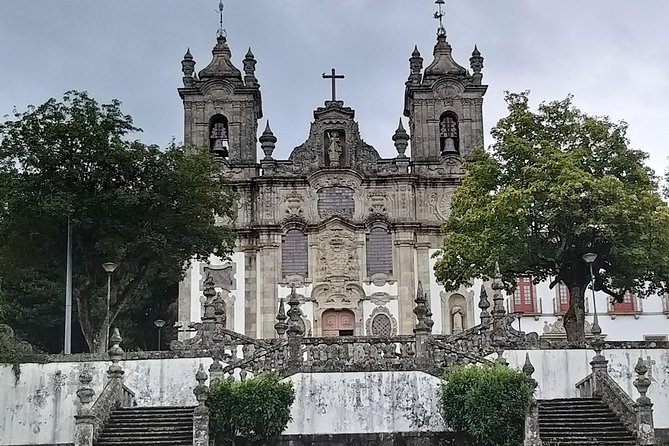
At Padrao do Salado, you’ll see a gothic porch built in the 14th century as a memorial of the Salado Battle. It’s one of those structures where the meaning matters as much as the stones.
The guide’s job here is important. Battle memorials can feel abstract if you don’t get the historical framing, and this tour is designed to supply that missing connective tissue. You’ll get a brief, focused look (around 10 minutes), enough to connect the monument to the medieval story of the region.
Free admission keeps the day smooth. The only drawback is timing: if you’re a slow walker or want to study architectural carvings up close, you may feel the stop is brief. The good news is a private format can sometimes help—ask for a little extra time if you’re really into details.
Medieval squares and the most medieval street in Guimarães
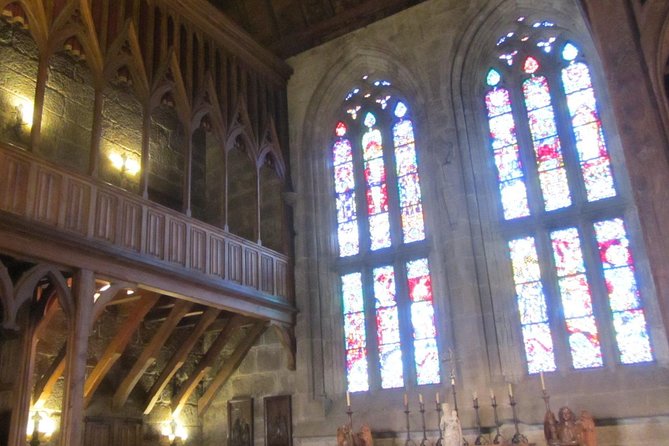
Praca de S. Tiago is the next stop: an ancient square that still preserves medieval features. Squares are where cities show their social life, even when nothing is happening in that moment. This one sets a mood before you move into the street-level medieval fabric.
Then comes Rua de Santa Maria, one of the first streets opened in Guimarães. The tour connects it to the Monastery of Guimarães (now Museum Alberto Sampaio) and the castle, and the guide can help you visualize how people moved through power centers. This street is called the most medieval street in Guimarães, and you’ll understand why when you look at the layout and the architectural testimonies lining it.
Plan on about 15 minutes here, and it’s free. The drawback: street stops are short by nature. If you want photos from every angle, you might want a few quick shots and save deeper photo time for later in the day.




Museum and palace choice: Paco dos Duques de Bragança
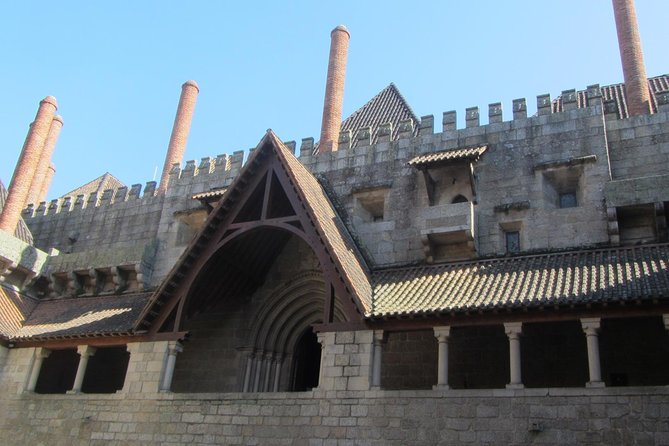
If you want to go beyond the exterior and see interior collections, Paco dos Duques de Bragança is the optional highlight. It’s a 15th-century palace that served as the residence of the Dukes of Braganza and now functions as a museum showcasing the region’s history. The tour lists the museum ticket as optional at €6 per person, with about 40 minutes allocated.
This stop is valuable if you like context that objects and rooms can give you. It’s also a relief if the day’s churches start to feel repetitive—palace interiors are a different flavor.
The tradeoff is obvious: you pay extra and spend more time. If your party prefers outdoor viewing only, you can skip it without breaking the overall arc of the day.
Igreja de São Miguel do Castelo: Romanesque with national importance
Igreja de Sao Miguel do Castelo is a small church with big significance. It’s a 12th-century Romanesque-style church, classified as a National Monument, and it’s linked to the period of the foundation of nationality. Even if the building is modest in size, the story behind it makes it feel heavyweight.
Expect about 10 minutes, free admission. Here’s the practical tip: take a moment to compare it in your head with the earlier religious site. The guide will help you connect the timeline, which makes each stop feel like a chapter rather than a random church photo.
Guimarães Castle: the views and the origin story
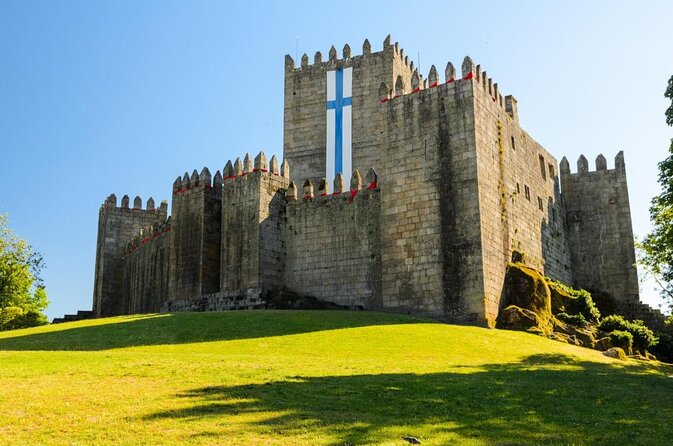
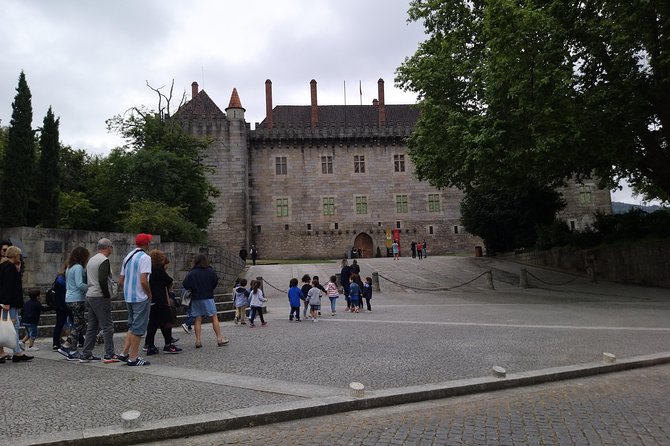
Next is Guimarães Castle, optional with a ticket listed at €2 per person and about 20 minutes allocated. The castle is described as a medieval structure built in the 10th century and known as the birthplace of the Portuguese nation, with stunning views over the city.
This is one of those places where the payoff is twofold: the historical meaning plus the panorama. If the weather is clear, you’ll likely feel it in your photos and in how the old city suddenly makes sense from above.
If the weather is poor or your legs are tired, skip it. The rest of the Guimarães portion is strong even without the castle. But if you want the classic hilltop finish to the Guimarães segment, this is the place.
Toural Square and Arco da Porta Nova for quick city rhythm
Back in the city flow, you have two more free stops designed for texture.
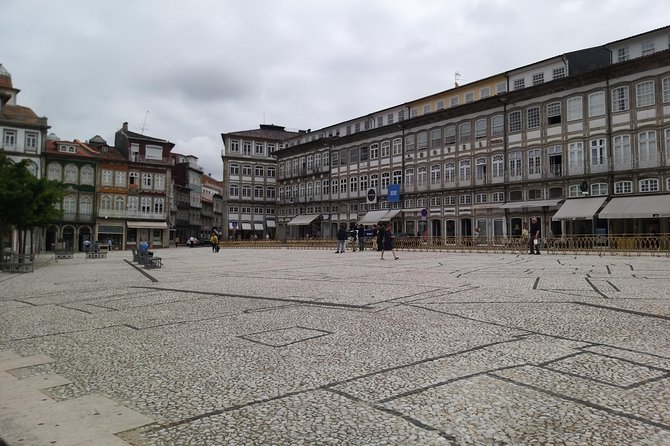
Largo do Toural is marked optional, about 15 minutes. It’s considered the heart of the city today, and historically it was outside the village main door, where cattle fairs and other products were held in the 17th century. It’s a good stop to understand how medieval and early modern Guimarães functioned day-to-day.
Arco da Porta Nova, the New Door, takes about 10 minutes and is also free. It sits at the top of Souto Street, a commerce artery. The arch shape you see today came together in the 18th century, which is a reminder that cities keep editing themselves long after the medieval page is written.
These are low-cost, low-commitment stops. The drawback is that they’re short. If you want to linger, you’ll need to plan on a bit of extra time in the schedule—or ask the guide for a minute or two more during the most important part for you.
Braga’s quieter elegance: Largo do Paço and Santa Barbara Garden
Once you reach Braga, the tone shifts. You start with Largo do Paco, with a building whose construction lasted from the 14th to the 20th centuries. Today it’s used by the rectory of the University of Minho and the Public Library of Braga. It’s the kind of civic-religious-modern overlap that makes Braga feel lived-in rather than frozen in time.
Then you’ll visit Santa Barbara Garden. Facing Santa Barbara Garden is a preserved medieval wing of the archiepiscopal palace, dated to the 14th and 15th centuries. This is a calm stop where the guide can connect the palace architecture to the broader city’s religious power.
Both stops are free and on the shorter side, with Santa Barbara Garden around 20 minutes. The possible drawback: if your group really loves gardens, you might wish this had more time. But as a reset between busier monuments, it works well.
Torre de Menagem and the remains of medieval defense
Braga’s defensive story is represented by Braga Tower (Torre de Menagem), the remnant of the Castle of Braga: the donjon and scattered pieces, tied to a 14th-century campaign. The tour frames this as part of a period of intense military construction, where medieval defense structures shaped both castles and urban fencing.
This stop is around 15 minutes and is marked as not included for the ticket. That means you may choose whether to pay depending on your interests. If you’re into military architecture, it can be a satisfying payoff. If you’re not, you still get useful context from the exterior and location.
Braga Cathedral area: where Romanesque, Gothic, and Baroque meet
The main architectural anchor is Santa Maria de Braga Cathedral. The cathedral dates to the 12th century and is described as a Roman Catholic cathedral with a mix of Gothic, Baroque, and Romanesque styles. The mix is a big deal because it’s not one style frozen in time—it’s a building that grew and changed with centuries.
It’s optional in terms of paid entry for the cathedral area (ticket listed at €3) plus associated fees for the museum (€3) and chapels and high choir (€2). The tour allocates about 45 minutes.
This stop is worth your attention because it’s the clearest place in Braga where the city’s layered religious development shows up in one visual sweep. The drawback is simple: you might feel pulled in multiple directions by the different areas inside. If you want fewer ticket add-ons, plan to focus on the cathedral itself and choose the museum or chapel sections only if they genuinely interest you.
Bom Jesus funicular and the UNESCO sanctuary above Braga
Now for the hill. Bom Jesus Funicular is optional at €2 per person, with about 15 minutes allocated. It’s a funicular with two booths moving along parallel tracks by cable, acting as counterbalance. The funicular is described as the first built in the Iberian Peninsula. The ride is 274 meters long, and each booth can carry 39 people including the driver.
It’s practical and scenic. Even if you’re not obsessed with engineering, the funicular reduces walking fatigue and gets you into the right mindset for the sanctuary.
Then comes Bom Jesus do Monte, the UNESCO World Cultural Heritage sanctuary, noted as UNESCO since 08 July 2019. Devotion is believed to be present since the 14th century, with the sanctuary construction beginning in the 18th century and lasting into the 19th. Admission is listed as free for this stop in the itinerary.
This part of the day is also where the tour’s viewpoint emphasis really pays off. The highlights mention a sanctuary on Penha mountain and a viewpoint over Guimarães too, so your time on elevated ground isn’t accidental—it’s designed to give you panoramic context and a break from street-level stone.
Price and what you should budget for real value
The tour price is $198.25 per person, with transport in luxury vehicles included. That base price matters because you’re paying for more than driving: you’re paying for comfortable round-trip logistics, a licensed guide/driver, and a private format.
What’s included:
- Luxury transport with Wi‑Fi, bottled water, and refreshments
- Personal accident and liability insurance
- Private tour with your group only
- English is offered
- Mobile ticket
- Pickup offered from Porto and Gaia downtown hotels and B&Bs
What costs extra (based on the listed optional or not-included items):
- Typical lunch: €30 per person
- Braga Cathedral Museum: €3
- Chapels and High Choir: €2
- Braga Cathedral: €3
- Palace of the Dukes of Braganza: €5
- Guimarães Castle: €2
- Bom Jesus Funicular: €2
A realistic way to think about value: the base rate is fair if you plan to use the included transportation and guide for the full day. If you also want the palace museum, both main viewpoints, and the cathedral add-ons, your total will rise—but you’re still getting a full day that covers both cities without you doing any routing work. The tour’s strength is that it bundles “hard parts” (getting there, timing, interpretation) into one organized day.
My practical advice: before booking, decide which paid choices match your interests. If you’re fee-sensitive, you can keep costs down by skipping the palace museum and funicular while still enjoying the free church and square stops.
Who this Guimarães and Braga private tour suits best
This tour fits best if you want a guided day with clear structure and the flexibility to tweak the day for your priorities. It’s ideal for:
- First-time visitors to northern Portugal who want a medieval hit without planning
- People who care about religious and civic architecture—and want interpretation, not just photos
- Travelers who value comfort in transit (Wi‑Fi and refreshments help a lot on longer days)
- Anyone who prefers a private pace instead of moving with a group
It might not fit as well if you hate added ticket decisions or you plan to skip most interior sites. Since several key experiences are optional or ticketed, you’ll either want to commit to a few paid stops or be comfortable keeping it exterior-focused.
Should you book this Guimarães and Braga private day?
Yes, I’d book it if your goal is a smooth, guided, medieval-and-hilltop day that starts in Porto at 8:00am and ends back where you began. The combination of Guimarães origin sites, Braga’s cathedral area, and the Bom Jesus sanctuary makes the day feel like a full cultural arc, not two disconnected bus rides.
Do it with confidence if you like the idea of a guide who can adjust the itinerary—especially with Carlos, who has a track record of working around what matters to your group and keeping explanations practical in English. Just make one decision early: which optional paid stops are musts for you. If you pick those in advance and plan for lunch costs, this becomes a very strong value for a private full-day tour.
FAQ
What is the duration of the private tour?
The tour lasts about 8 to 10 hours.
What time does the tour start, and where does it begin?
It starts at 8:00am from Praça da Liberdade 19, 4000-322 Porto.
Is pickup available from hotels in Porto and Gaia?
Yes. Pickup is offered from all Porto and Gaia downtown hotels and B&Bs.
Is this tour private?
Yes. It is a private tour/activity, with only your group participating.
What language is the tour offered in?
The tour is offered in English.
What’s included in the tour price?
Transport in luxury vehicles with Wi‑Fi, bottled water, and refreshments, plus personal accident and liability insurance.
Is lunch included?
No. Typical lunch is not included and is listed at €30 per person.
Which major stops require optional tickets?
Optional tickets listed include the Palace of the Dukes of Braganza (€5 per person in the not-included section) and Guimarães Castle (€2 per person), plus Bom Jesus Funicular (€2 per person).
Are there any free admissions on the itinerary?
Many stops are listed with free admission tickets, including several church and square stops in Guimarães and Bom Jesus do Monte.
What happens if weather is poor?
This experience requires good weather. If it’s canceled due to poor weather, you’ll be offered a different date or a full refund.
Are service animals allowed?
Yes, service animals are allowed.