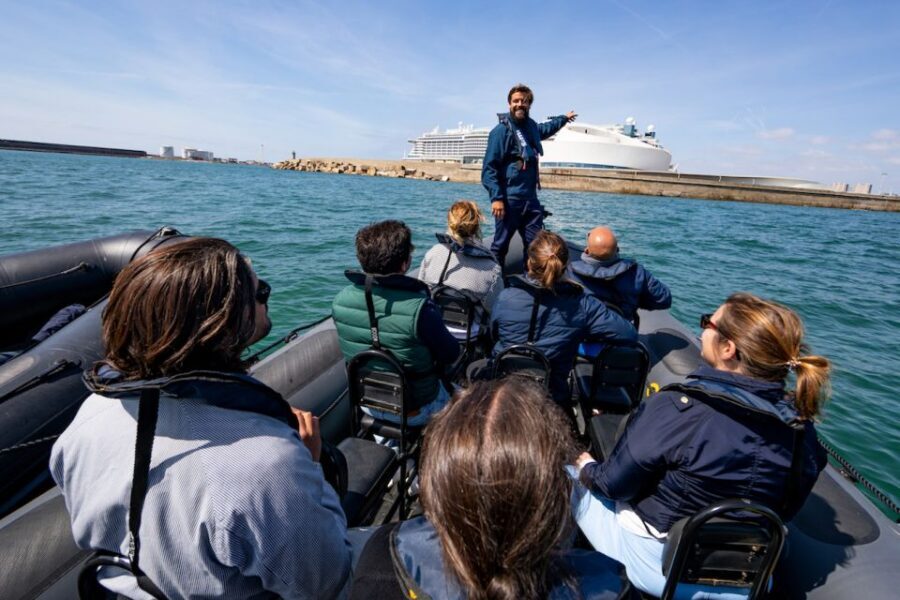
This short boat trip gives you a clear look at Aveiro’s canals and the stories behind what you’re seeing. I like that the guide keeps it lively, with explanations in English, plus a free tasting of something local at the end.
One thing to consider: it’s brief, so if you want a long, scenery-heavy cruise, you may find it a bit light. Also, language can be a factor if you’re booking under a different language than what’s operating.
In This Review
- A smart way to get your bearings on the Ria
- Key highlights worth aiming for
- Entering The Aveiro canal loop: 45 minutes with real context
- The boat ride itself: what you’ll actually see
- Stop by stop: the stories behind Aveiro’s canals
- Seeing Aveiro’s 4 main urban canals and getting the guide’s secrets
- Main channel of the city: where the water shapes the view
- Partnership in stone and iron: Silva Rocha and Ernesto Korrodi
- The Major Pessoa House: Art Nouveau character you can feel
- Capitania dos Arcos: when tides, mills, and design meet
- Cultural and Congress Center: industrial architecture plus Maria da Fonte
- Egg-sweet shapes in sculpture: the city’s taste turned into form
- Forum Aveiro: the open-air shopping center in the city’s center
- Salpoente and the old Armazéns de Sal: salt storage turned into dining
- Bronze statues at Praça Humberto Delgado: four figures, one canal bridge
- The floodgates and the salt marsh view: the practical side of Aveiro
- Value for your money: what’s included, what to watch, what you’ll likely do next
- Logistics that affect your experience (without getting in the way)
- Who this cruise fits best
- Should you book Aveiro Com Paixao’s canal cruise?
- FAQ
- How long is the Aveiro canal cruise?
- What language is the tour offered in?
- How big are the groups?
- What does the ticket include?
- What is not included?
- Where does the tour start and end?
- Do I need good weather?
- Is a mobile ticket used?
- Are service animals allowed?
- What’s the cancellation policy?
A smart way to get your bearings on the Ria
The route focuses on Aveiro’s main urban channels, with stops that connect buildings, art, and local traditions to the water around them. Expect a group up to 50 people, a ride designed for getting oriented, and a chance to notice practical details like the floodgates that help control water levels inside the city.
Key highlights worth aiming for
- 4 main urban canals views that help you understand how Aveiro is laid out around the water
- An English-speaking guide who adds humor and clear commentary
- A free Aveiro product tasting, plus discounts with local businesses
- Stops that mix Art Nouveau and industrial architecture, not just canal scenery
- A look toward the Ria salt marshes and the water-management system
Entering The Aveiro canal loop: 45 minutes with real context
If you’re in Aveiro for a day (or even just a half-day), this kind of cruise works like a shortcut. You don’t need to guess where everything is; the guide points, explains, and makes the city feel less like a postcard and more like a place with patterns—canals, industry, art, and the tides.
The timing is the big deal. You’re on the water for about 45 minutes, which means you can use it as your first move—then go explore on foot afterward. The ride is set up to be friendly and fast-paced rather than long and slow.
You’ll also want to know what you’re paying for. At about $15.16 per person, you’re not just buying boat time. You’re getting a guided introduction, a ride along the city channels, and a free tasting of a typical Aveiro product in the experience space after. On top of that, there’s a discount on local businesses, which can quietly add up if you plan to eat or buy small souvenirs.
The boat ride itself: what you’ll actually see
This cruise is built around Aveiro’s urban channels of the Ria de Aveiro. The boat time is organized as a guided loop where you’ll get views from the water of key canal corridors.
From the reviews, the most praised part is simple: it’s fun, quick, and a good start. People also highlight that the boats are clean and nice, and the guide’s English is strong, with an upbeat style. That matters because on a short tour, you want every minute to feel useful.
Also, you’ll likely notice the “city-water” feel of Aveiro right away: canals lined with buildings, bridges, and architecture that you can’t see the same way from the street. Even if some parts feel straightforward (industrial and civic buildings, not only pretty facades), the water-level perspective helps it all click.
One practical note: the activity requires good weather. If the day turns cloudy or rainy enough, you may be offered another date or a refund, so keep an eye on forecasts.
Stop by stop: the stories behind Aveiro’s canals
This tour runs like a walking tour would, except your “sidewalk” is the canal. Here’s how each major stop fits together and what it means for you.
Seeing Aveiro’s 4 main urban canals and getting the guide’s secrets
The first phase is the orientation part. You’re onboard with guides who explain what’s around you, including “secrets” of Aveiro—small pieces of local knowledge that help you interpret the city as you pass it.
Why it matters: Aveiro isn’t just canals and boats. It’s a working coastal landscape turned into a city identity. When the guide points out details (and you can see them from the water), you start understanding why certain buildings sit where they do and why the city developed along these corridors.
What to expect: a guided narration while you pass the canal viewpoints. You’ll likely feel like you’re being shown a route, not just taken in circles.
Main channel of the city: where the water shapes the view
The route then brings you along the main channel. This is the stretch where Aveiro’s layout reads most clearly from the boat.
If you’re the type who likes to photograph, this is usually your “set up your camera” stretch—because big views and strong angles appear when the boat aligns with the central waterway. If you’re more interested in understanding the city than shooting photos, this part is still helpful because it anchors the rest of the tour.
Partnership in stone and iron: Silva Rocha and Ernesto Korrodi
One of the named stops focuses on the collaboration between Silva Rocha and Ernesto Korrodi and how it shows up in a standout building. This partnership is described as “practical translation” of the originality and talent of both artists.
From the water, the payoff is in the facade details. The building is known as an architectural highlight, with skillfully sculpted stone mixed with wrought iron, tied to an artistic movement you’ll see echoed across Art Nouveau-style architecture.
The eagle on the facade is specifically mentioned as a notable feature. Even if you don’t study facades the way an architecture fan would, this kind of detail is the sort that makes the guide’s stops feel more than generic sightseeing.
What to watch for: the combination of materials on the outside. Stone texture plus wrought iron forms gives you depth you can’t always spot from street level.
A small bonus: the building currently functions as a museum of art and a tea house, and at the end of the day it becomes a bar. So even if you can’t pop inside during the cruise, the stop helps you understand that the architecture is still in active use.
The Major Pessoa House: Art Nouveau character you can feel
Another stop centers on the Art Nouveau Major Pessoa House. This is part of the same visual language as the earlier Silva Rocha/Korrodi mention—so you’re likely to see a consistent theme: ornament, facade storytelling, and a city that expresses creativity through its public-facing buildings.
This is especially worth your attention if you like design and want more than “pretty canal views.” Aveiro’s architecture here isn’t random; it connects to the artists and the city’s identity.
Capitania dos Arcos: when tides, mills, and design meet
Next up is the captaincy building of the Port of Aveiro, also called Capitania dos Arcos. The tour framing here is all about long history and strong architectural quality.
What makes it interesting isn’t just age. The details you’re given help you picture how Aveiro’s coastal life worked:
- The first floor dates to 1830, built on arcades of a tidal mill.
- It later served as support for the porcelain-related activities that connect to Vista Alegre.
- In 1903, a second floor was added for the School of Industrial Design, operating until 1918.
- It then shifted to private ownership and tile panel placement, and later (in 1925) to Ministry of the Navy services for captaincy work.
- In the late 20th century, it underwent renovation for municipal assembly use, and today it works as an art gallery.
From a tour standpoint, this stop gives you a “why” behind the waterfront. Aveiro isn’t only decorative; it’s a city that managed water, industry, and education.
Possible drawback: if you’re expecting only pastel canals and boats, these civic and industrial buildings can feel more “information-heavy” than visually romantic. But if you enjoy learning how places function, this is one of the most valuable parts.
Cultural and Congress Center: industrial architecture plus Maria da Fonte
Another stop is the Cultural and Congress Center, described as part of an emblematic industrial architecture building originally known as Fábrica Jerónimo Pereira de Campos.
From the information provided, this building was built between 1915 and 1917, with a project by Architect José Olímpio. Since the center opened in 1995, it has become a place for congresses, meetings, exhibitions, concerts, and plays.
But the tour also highlights a specific feature you can connect to stories: the statue of Maria da Fonte located in an artificial lake. You’ll be told that a puritan movement shocked by the statue’s nudity removed it from its original location. The statue was moved to Parque Infante D. Pedro and later returned here for luck connected to young unmarried girls.
The tour frame here even compares her fate to famous figures like Maneken Pis and the Copenhagen mermaid, with the note about miraculous abilities. That kind of humor and cultural context is exactly the sort of thing that makes a short cruise memorable.
Egg-sweet shapes in sculpture: the city’s taste turned into form
Then you pass a sculptural set of five elements connected to traditional Aveiro egg sweets—three shaped like the familiar forms (the barrel, the mussel, and the whelk) and two displayed in parallelepiped form as if the elements were removed from an excavated mold.
This stop is small but smart. It reminds you that local food traditions aren’t just something you eat; they become part of public art and identity.
If you like food culture, this is a great moment to mentally connect what you’ll taste later (or already tasted) with what you’re seeing on the street and in city design.
Forum Aveiro: the open-air shopping center in the city’s center
The tour also includes Forum Aveiro, opened in 1998, described as the first open-air shopping center in Portugal. The big idea here is that gardens, green areas, and public spaces predominate.
This section can be hit-or-miss depending on your interests. If your trip is about architecture, you’ll find it useful because it’s tied to how Aveiro blends modern civic spaces into the urban plan. If you came only for canals and seafood, this portion may feel more like a quick “passing reference.”
Still, it’s in the center of town, and it links shopping culture to the idea of public spaces—not just a mall dropped into the city.
Salpoente and the old Armazéns de Sal: salt storage turned into dining
Another stop is Salpoente restaurant, located at Cais de São Roque, and described as bringing together two old Armazéns de Sal—historical salt storage heritage.
What you get here is a straight connection between the Ria economy and the way Aveiro eats today. The description emphasizes that Salpoente is a tribute to the people and raw materials of the Ria de Aveiro region, recreated in excellent cuisine, in a modern environment that pays homage to art and tradition.
Even if you’re not dining there right after the cruise, this stop helps you understand why Aveiro has such a strong seafood and salt identity. It’s not random menu branding; it’s linked to real infrastructure.
Bronze statues at Praça Humberto Delgado: four figures, one canal bridge
The tour ends by referencing bronze statues placed at the ends of the bridge over the central canal in Praça Humberto Delgado.
There are four full-length statues (with dimensions below real size), representing traditional figures:
- Salineira (a salt worker) holding a canasta on her head
- Marnoto (salt labor) with instruments characteristic of salt work
- Parceira do Ramo wearing traditional feminine feast-day clothing and holding flowers for new stewards
- Fogueteiro with the rocket, dressed in traditional festival Sunday attire
Why this matters: it turns “Aveiro” into people and rituals. Instead of only buildings and water, you see how city life is celebrated through specific roles tied to salt work and festival traditions.
If you plan to explore on foot afterward, this is useful because you can later locate and study these statues yourself. From the water they’re seen as a group; later you can appreciate each figure up close.
The floodgates and the salt marsh view: the practical side of Aveiro
The tour also takes place along the urban channels of the Ria de Aveiro, and along the way you can glimpse salt marshes and observe the floodgates that control water levels to prevent flooding.
This is one of those details that makes the city feel real. You’re not only seeing pretty canals; you’re seeing how Aveiro manages its relationship with the tide and the lagoon system. If you like engineering, water management, or just want to understand why things look the way they do, this part adds weight.
If you want purely scenic vibes, you might skip this mental layer and just enjoy the ride. But it still helps you connect the dots for the rest of the city.
Value for your money: what’s included, what to watch, what you’ll likely do next
For about $15.16 per person, you’re buying:
- a tourist guide
- the boat ride
- a discount on local businesses
- a free tasting of a typical Aveiro product in the store/experience space
So even if you only care about the views, the tasting is a small extra payoff that you might otherwise have to pay for elsewhere. And the guide is the key: without a good guide, canal tours can feel like “sit and pass time.” The strong English and humor come up in the feedback you provided, which is exactly what you hope for on a short tour.
What’s not included: photographs. The cost is 10€ per photo with a frame included. If you think you’ll want picture souvenirs, plan for that cost. If you don’t, just focus on your own photos and skip the add-on.
Logistics that affect your experience (without getting in the way)
This is a mobile ticket style experience, and it ends back at the meeting point. It runs with confirmation at booking, and it’s capped at 50 travelers, which usually helps keep the guide’s voice useful.
The meeting point is listed using a pin-like location in Aveiro (J8RV+G8 Aveiro / J8RV+G85 Aveiro). Since the activity ends at the same place, you can plan a follow-up meal or walking route without complex navigation.
One more real-world consideration: there’s a language mismatch risk. One unhappy review points out a situation where an Italian booking didn’t match the guide availability, and the guide in Italian was not there. So if language is important to you, double-check what language is operating.
Who this cruise fits best
This works well for:
- first-time visitors who need a quick orientation to Aveiro’s canal layout
- couples and friends who want something easy and not too time-consuming
- people who like mix-and-match sightseeing: canals plus architecture plus local traditions
- anyone who values a guide who can explain without making it boring
It may not fit as well if:
- you want a longer cruise with fewer stops
- you’re only into scenic nature views and less into civic/industrial architecture
Should you book Aveiro Com Paixao’s canal cruise?
I’d book it if you want a short, guided canal overview and you like learning what you’re seeing. The strong point is efficiency: you get major canal views, Art Nouveau and industrial architecture stops, and a tasting payoff—without taking half your day.
Skip it (or at least adjust expectations) if you’re looking for a long, quiet boat drift or a tour with lots of time for slow wandering. It’s meant to be quick, with the guide doing the heavy lifting so you can move on after you’ve got your bearings.
If you’re weighing this against other Aveiro options, think of it as your first “chapter.” Then use what you learn from the water to guide where you walk next.
FAQ
How long is the Aveiro canal cruise?
It lasts about 45 minutes.
What language is the tour offered in?
The experience is offered in English.
How big are the groups?
The tour has a maximum of 50 travelers.
What does the ticket include?
It includes a tourist guide, the boat ride, a discount on local businesses, and a free tasting of a typical Aveiro product in the store/experience space.
What is not included?
Tour photos are not included. They cost 10€ per photo with a frame included.
Where does the tour start and end?
The tour starts at the listed meeting point in Aveiro (J8RV+G8 / J8RV+G85) and ends back at the same meeting point.
Do I need good weather?
Yes. The activity requires good weather. If it’s canceled due to poor weather, you’ll be offered a different date or a full refund.
Is a mobile ticket used?
Yes, it uses a mobile ticket.
Are service animals allowed?
Yes, service animals are allowed.
What’s the cancellation policy?
You can cancel for a full refund up to 24 hours in advance. If you cancel less than 24 hours before the start time, the amount paid won’t be refunded.